An embedded strategy for large scale incompressible flow simulations in moving domains
Ramon Codina, Joan Baiges, Inocencio Castañar, Ignacio Martínez-Suárez, Laura Moreno, and Samuel Parada · Journal of Computational Physics, 488, 112181.
Finite element simulation of complex flows in realistic geometries
Selected engineering applications
During my doctoral research, I also applied computational fluid dynamics to two large-scale engineering problems: atmospheric-flow effects around astronomical telescopes and the transient aerodynamics generated by a train moving through a tunnel.
01
Engineering application I
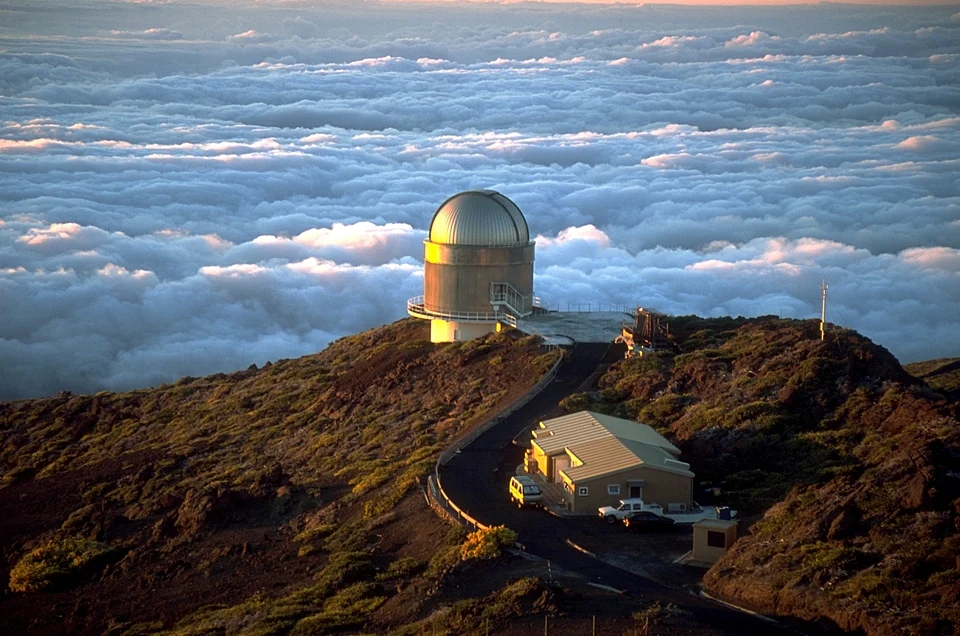
The European Solar Telescope project required assessing whether the future EST could degrade the optical quality of the nearby William Herschel Telescope at the Roque de los Muchachos Observatory. The problem connects external aerodynamics with thermal transport: wakes and temperature fluctuations produced around one telescope can alter the refractive properties of the air through which another telescope observes.
Starting from CAD models supplied by the Instituto de Astrofísica de Canarias, we constructed a three-dimensional computational domain incorporating the telescopes and the real surrounding terrain. We then solved the incompressible Navier–Stokes and temperature equations and used the resulting thermal field to evaluate optical-turbulence indicators.
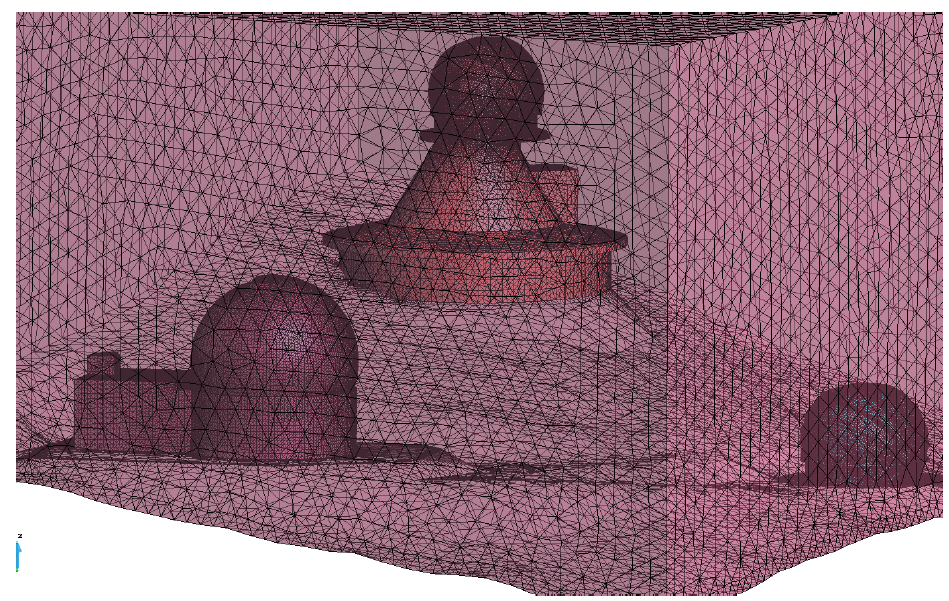
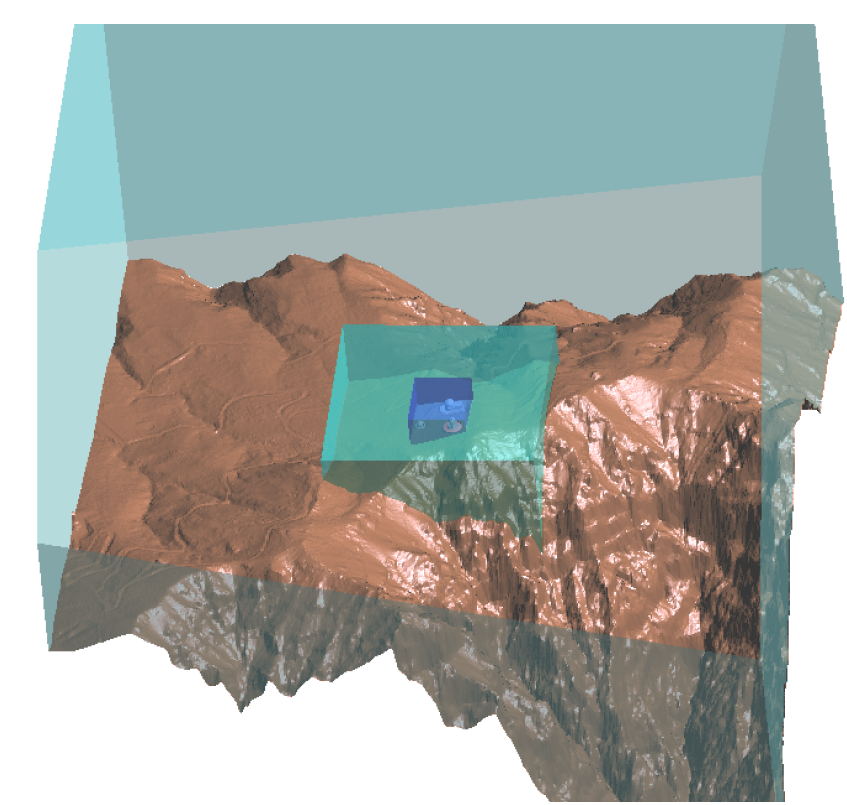
Selected simulation fields
The simulation resolves how the terrain and telescope geometries reshape the wind field and its wake. The coupled temperature solution then provides the information required to estimate fluctuations in the refractive index of air and assess their possible effect on astronomical observations.
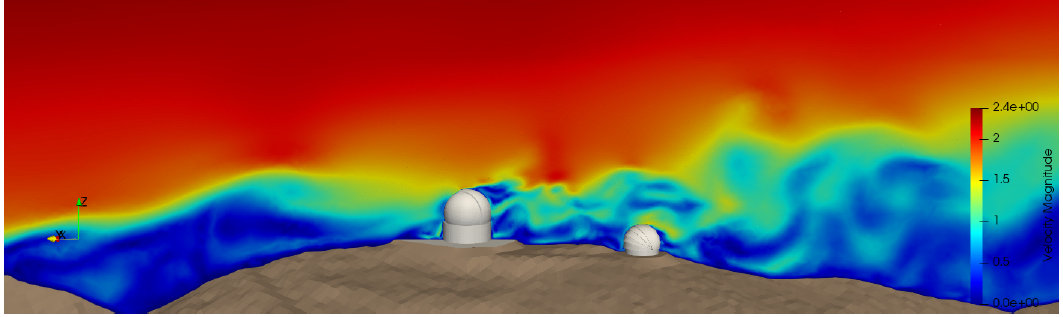
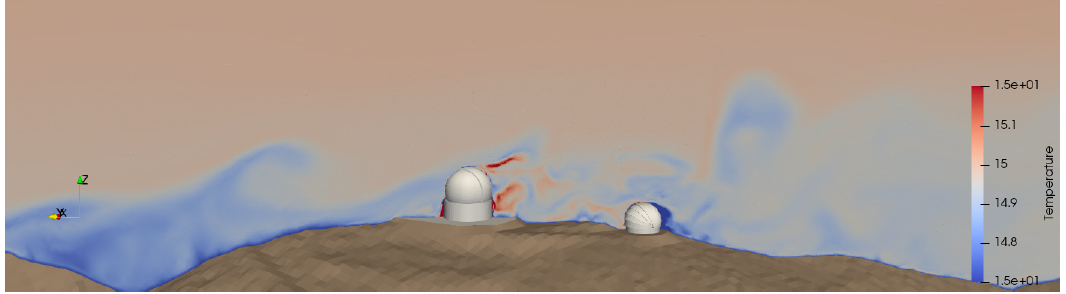
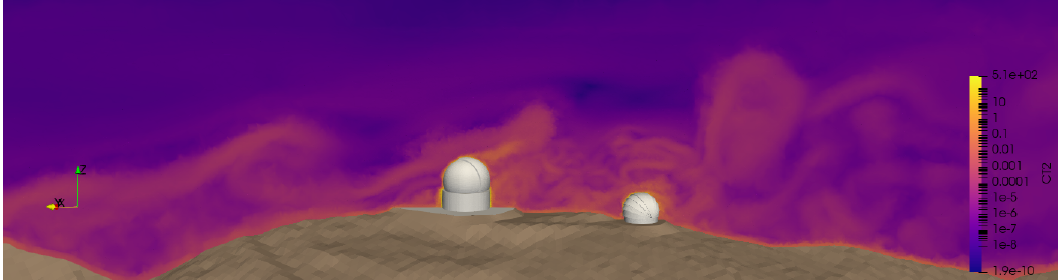
What the study connects: a realistic CFD calculation becomes an optical-quality assessment by linking terrain-resolved wind, turbulent mixing, temperature transport, and atmospheric refractive-index fluctuations.
02
Engineering application II
This project studied the transient aerodynamic loads generated as a train travels through tunnel sections of different shape and cross-sectional area. The practical objective was to evaluate pressure peaks for the structural design of fire-resistant panels installed on the tunnel separation wall.
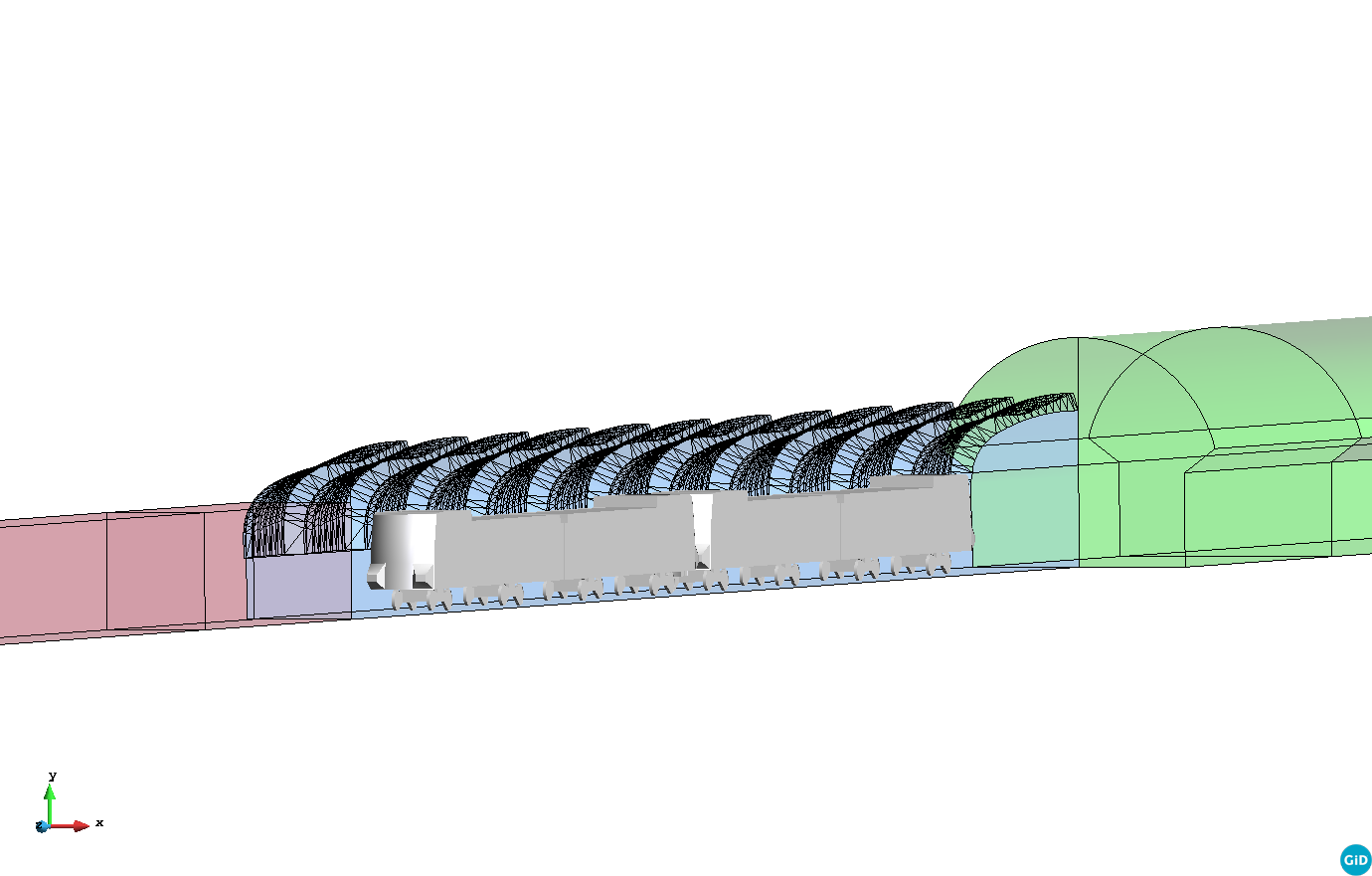
The train moves at 100 km/h through a 590 m computational model containing narrow, curved, and wide tunnel sections. Representing this motion with a body-fitted mesh would demand severe mesh deformation or continuous remeshing, so the problem was solved using an embedded fixed-mesh strategy.
Embedded strategy
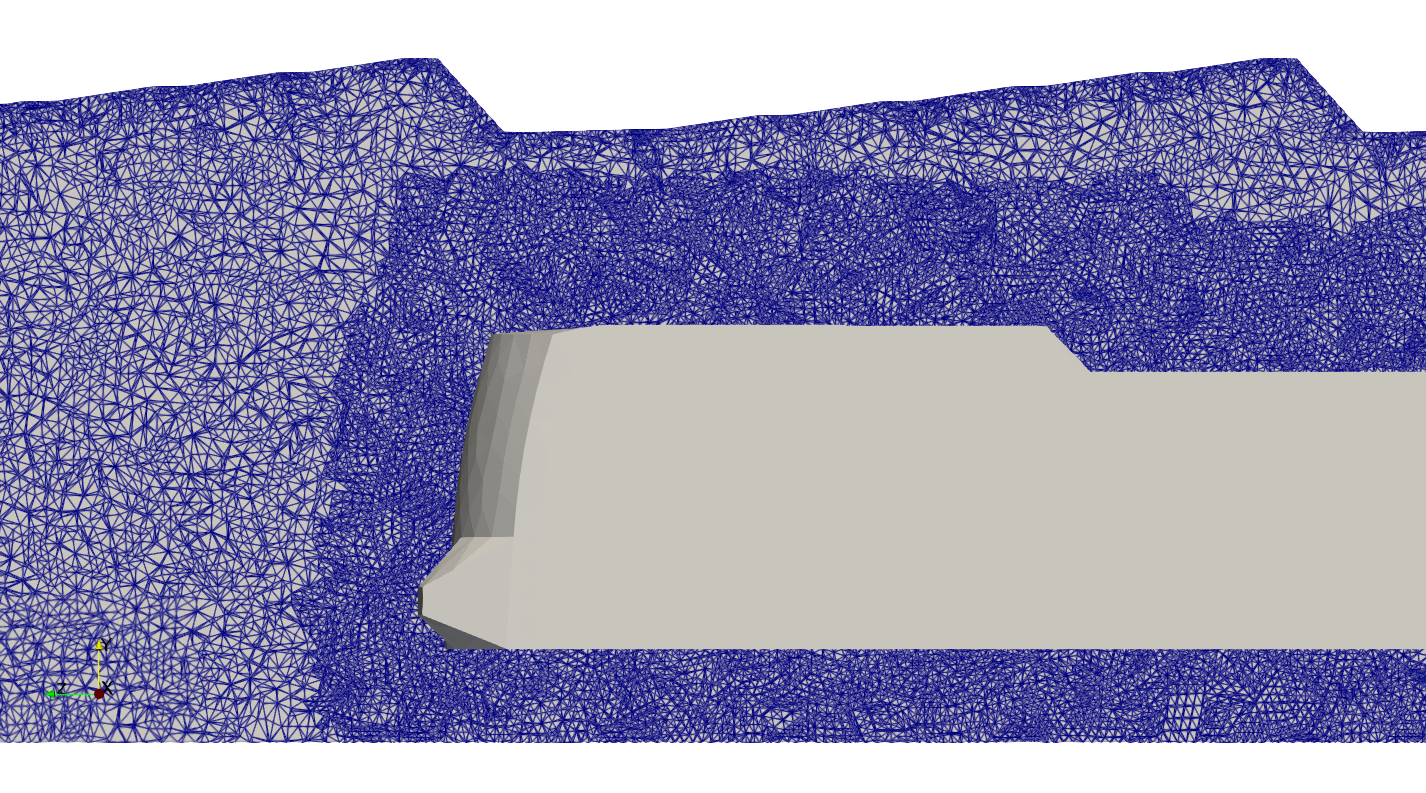
A foreground mesh represents the train and follows its rigid motion. The incompressible flow is solved on a fixed background mesh representing the tunnel. At every time step, the train position and velocity are transferred to the background discretisation and imposed weakly on the cut elements using Nitsche's method.
Selected results
The moving train pushes air ahead of its nose while drawing a wake behind it. Flow separation creates vortices along the train and at sharp tunnel edges; the highest pressure occurs near the nose, while the strongest suction develops around the tail.
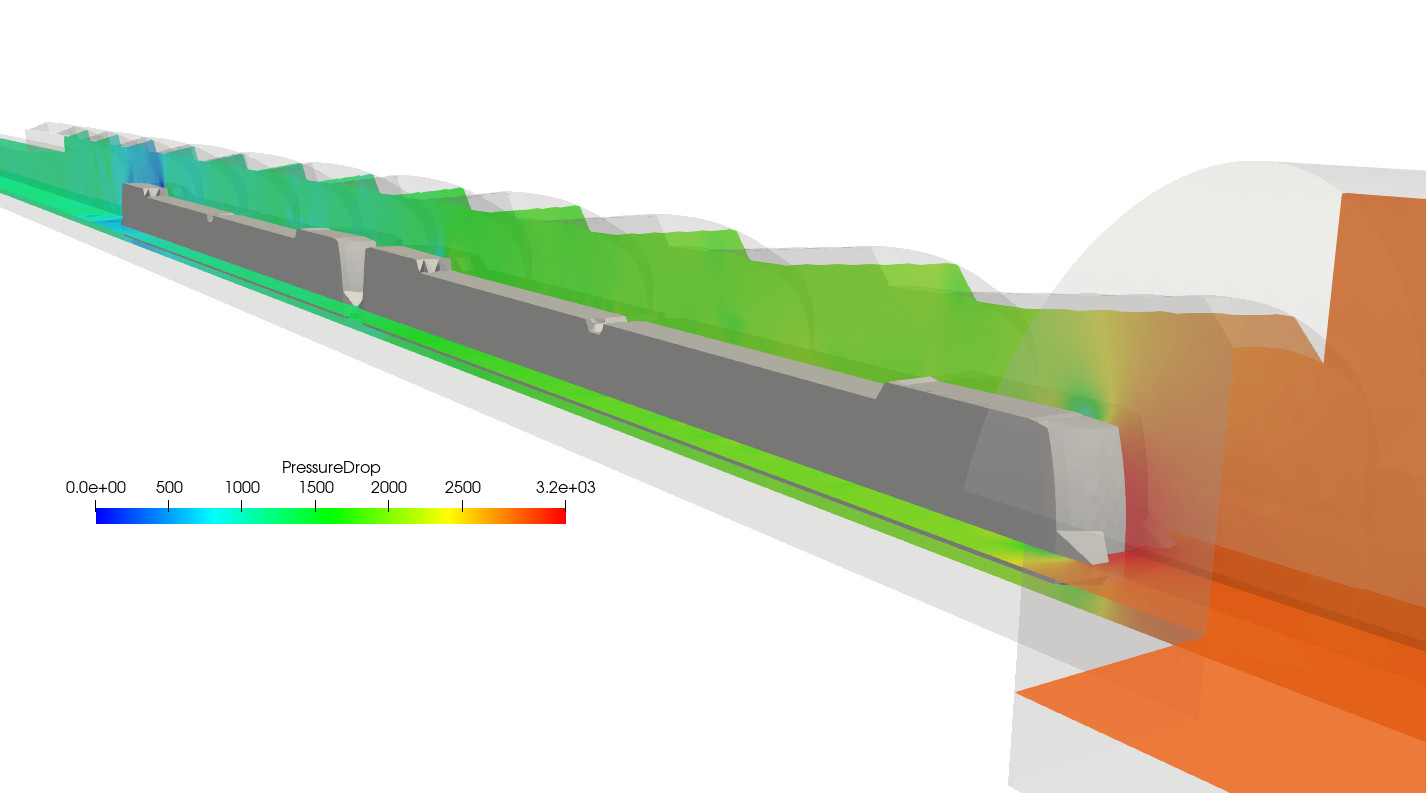
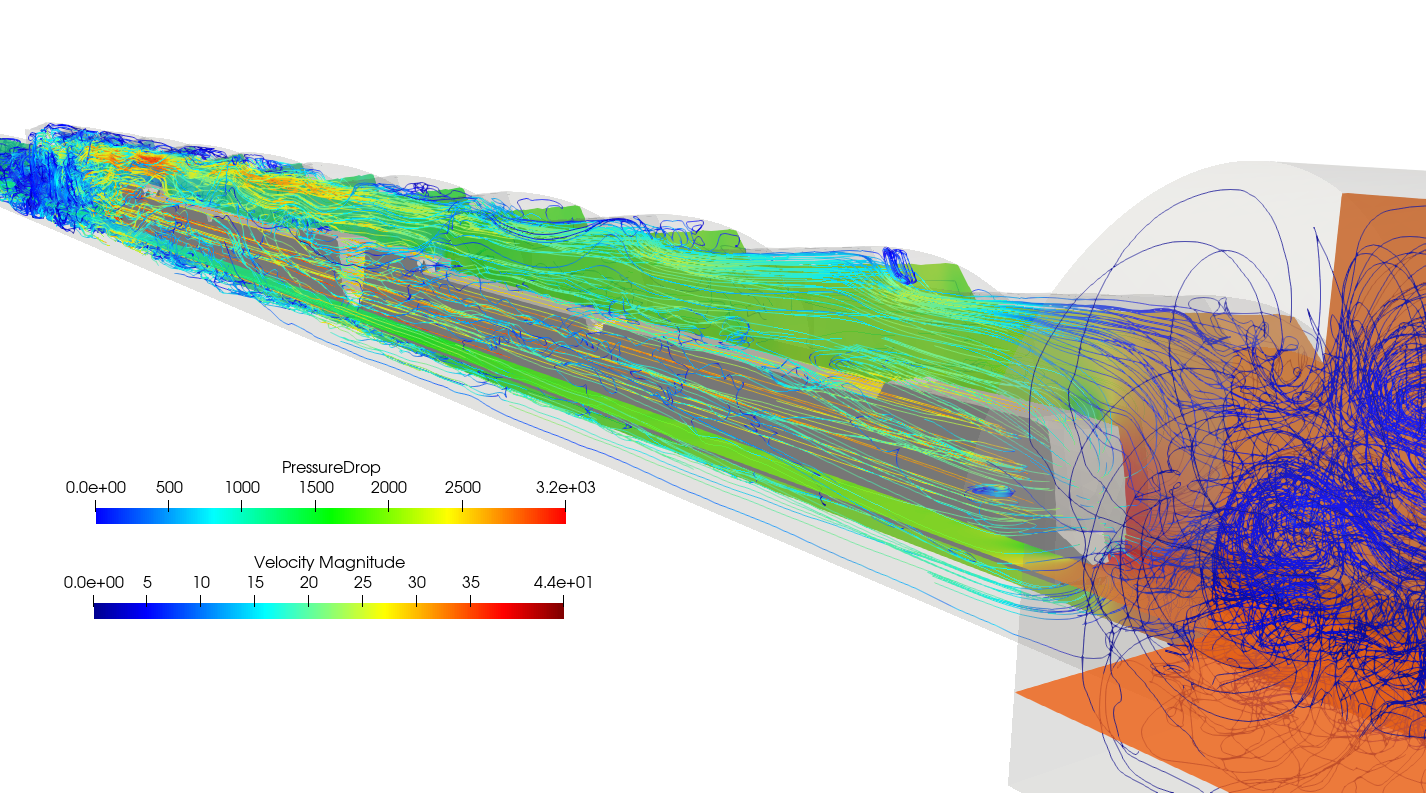
What it demonstrates: the fixed-mesh ALE formulation transfers the motion of a geometrically detailed train to a fixed flow mesh, enabling a fully transient, large-scale calculation that would be difficult to perform with a conventional ALE mesh.